
HOME

games

systems

ux / ui
DAMIEN ZEMANEK
Systems Portfolio

Pipeline (2025)
Technical Programmer - Systems Engineer
C# - SYSTEMS ARCHITECTURE - ASYNC
Internal middleware pipeline
Fuent-api step composition
Immutable context delivery
Async execution optionality
Explicit before/short-circuit/after resolving
PIPELINE
ROLE: C# Systems architect - PROGRAMMER
Highlights
overview
INfo
Language: C#
Team Size: 1
Time Frame: 5 weeks + Updates
Target Engine: Unity3D
Contribution
Built internal middleware pipeline system based off SWE middleware pattern with type-safe immutable context delivery
Created pipeline builder for fluent-api style step composition
Built separate pipeline executor adhering to SOLID principles
Created PipelineStep data-structure to house step type, logic, and resolution logic
Integrated with custom Timer system for player-loop plug and play
Constructed with custom SRP Resolver system for extra-specific functionality branching
Build NUnit and Unity TestRunner test suite
introduction & goals
Pipeline was my first major Systems Design project I worked on to solve an issue I had where I needed to pass immutable, readable information at a performant, fast and consistent rate. Serving as a sub-system of my larger MonoFacade system.
In order to design this system I went through a research phase, ideation and greybox, development, testing through developing a test suite, and integration with other systems to complete this project. I plan to continue to update this project overtime and have it as a core system apart of my EMILtools system library.
1. RESEARCH PHASE
Compiled releavant research videos
Studied concepts to understand design constraints & system purpose
Took notes and wrote down what I wanted to actually design in accordance with research/what I would take from the videos
2. diagram greybox phase
Kept in mind design constraints, greyboxed initial code flow
Used FIGMA to create diagrams tha representated high-level abstractions
Saved and iteratedon design flow when changes were made
3. development phase
What i did
Data structure & system design
Created a
Pipeline<TViewCtx>data class to holdPipelineStep<TViewCtx>data structure classes to separate data handling responsibilityComposed
PipelineStep<TViewCtx>withStepTypeenum, and option to either have a callback, or a predicate resolution with custom predicate classesDefined a
IContextViewImmutableinterface to serve as a generic constraint for<TViewCtx>to ensure compile-time type safetyCreated a
PipelineBuilder<TViewCtx>builder pattern class to separate construction of pipelines and composition of steps for locality of behavior. Builder class usesAdd_ShortCircuit(),Add_Middleware(), andInjectMainMethod()public methods to compose pipelines modularly.
NUnit and Unity TestRunner Test Suite
Build a comprehensive NUnit + Unity TestRunner framework suite validating pipeline composition, short-circuit flow, execution, async/timed behavior integration with custom
Timerssystem,Ensured step composition ordering correctness and context devivery
Resolver system integration
Integrated a custom
Resolversystem to abstract execution of pipeline actions (callbacks, waits, timers) decoupling step definition from runtime behvaiour & separated out execution responsibility toPipelineExecutor<TViewCtx>to manageResolverintegrationDesigned pipeline steps to resolve through a unified
IResolvableinterface, allowing synchronous, asynchronous and time-based operations to be composed uniformly within the same execution paradigm
KEY DESIGN ANALYSIS & WHAT I LEARNED
KEY DEsign analysis
why pipeline?
Decomposes complex execution into sequential, and isolated stages, improving readability, testability, and maintainability over complex logic webs
Enables composible, modular, and extensible behaviour, where steps can be added, removed and or re-ordered without rewriting system flow
why resolver abstraction?
Decouples what a step does from how it executes, allowing callbacks, async waits, and timed operation handling through a unified exaction abstraction
Creates a extensible plug-and-play abstraction layer that allows for new behaviours (timers, async, gates) to integrate with pipeline execution without modifying pipeline logic, improving scalability & system longevity
Why immutable context delivery?
Guarantees read-only safety across system boundries & creates a snapshot of system state avoiding race condition problems.
Why short-circuit model?
The original reason for this system, serving as an advanced way of guard-clausing, providing early exit control flow preventing unnecessary work and allowing failure or gating conditions to stop execution
Creates conditional orchestration, where steps can branch behavior (before/after/fail) while enforcing strict execution guarantees and not bloating code with complex nested logic.
What i learned
Context Immutability Design
There are different levels to immutability in different programming layers to make data immutable.
I chose interface-level immutability to prevent reference mutation while maintaining ergonomic usage.
This means making the context be immutable at the class level, so it looks like this:
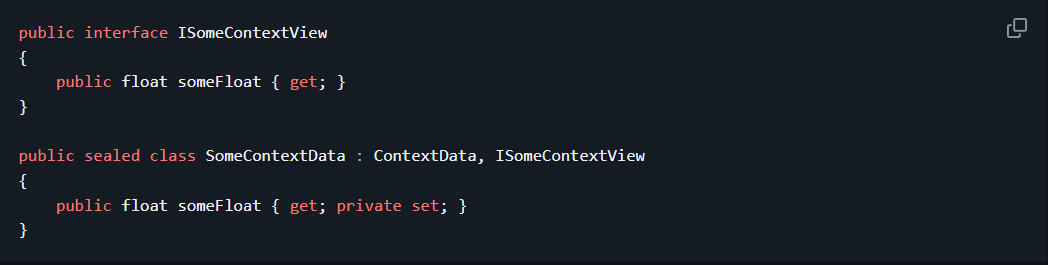
The neat thing about this is that the implementation of the
ContextViewinterface is integrated within the{ get; private set; }definition of the concrete class. Meaning there are no extra semantic indirection.
Performance Considerations for Data Throughput
Another important peice of information I gleaned is that high-throughput is important for systems that constantly send data around.
Meaning using value-types even if the data is small, is not a good design decision based on the rate at which data is sent.
The pipeline system is designed for the Unity Player Loop, meaning it can hook into Update, FixedUpdate, etc.
Therefore the execution can be called every frame. This would be a problem with a value-type system.
However using reference-types the issue of rapid copies creating many one-shot copies is avoided.
INTERESTED IN MY WORK?
LETS DISCUSS!